Pentadeca arginate surgery support reduces post-op inflammation and speeds tissue repair, addressing the two factors most likely to extend recovery time after a procedure. PDA is the arginate-salt form of BPC-157, sharing the same 15-amino-acid sequence and tissue-repair mechanism. Human studies show clinically meaningful pain relief and accelerated wound repair across multiple tissue types. A licensed provider at Vita Bella evaluates whether PDA fits your procedure timeline before recommending a perioperative protocol.
| Phase | Primary goal | Mechanism |
|---|---|---|
| Pre-surgical | Reduce baseline inflammation, condition soft tissue | Angiogenesis support, anti-inflammatory signaling |
| Immediate post-op | Limit pain, protect recovering tissue | Cellular repair signals, microcirculation improvement |
| Rehabilitation | Restore range of motion, hit functional milestones | Collagen synthesis, tissue remodeling |
What is pentadeca arginate used for?
PDA is a tissue repair peptide used to reduce inflammation, support wound repair, and improve recovery after joint injuries, partial muscle and tendon tears, and surgical procedures. It promotes angiogenesis, collagen synthesis, and cellular repair at the site of injury or incision.
A 2021 review in Frontiers in Pharmacology (Seiwerth et al.) confirmed BPC-157's ability to accelerate repair across excisional wounds, deep burns, and diabetic ulcers, noting its stability in human gastric juice. The relevance to pentadeca arginate surgery care is direct: better vascular supply and faster cellular turnover at the wound bed.
For PDA for knee pain, Lee & Padgett (2021) found that 91.6% of patients receiving intra-articular BPC-157 reported significant improvement, with benefits persisting well past the three-to-six-month mark. That durability is what makes PDA a credible surgical recovery peptide, not just a short-term analgesic adjunct.
How does PDA compare to BPC-157 for recovery?
PDA and BPC-157 share the same 15-amino-acid core. PDA is the arginate-salt form, often preferred for compounding pharmacy preparation. As a BPC-157 alternative, the PDA peptide is expected to perform identically in recovery contexts because the active sequence is unchanged.
Human data on BPC-157 directly inform what to expect from PDA. Lee & Padgett (2021) found 87.5% overall improvement in knee pain patients, with durability well past the three-month point. That kind of sustained outcome matters for recovery-focused peptide programs, where the goal is complete tissue remodeling rather than short-term management.
Both compounds modulate nitric oxide signaling, support vascular repair, and reduce inflammatory signaling at the tissue level. The formulation differs. The mechanism does not.
When should you start pentadeca arginate surgery support?
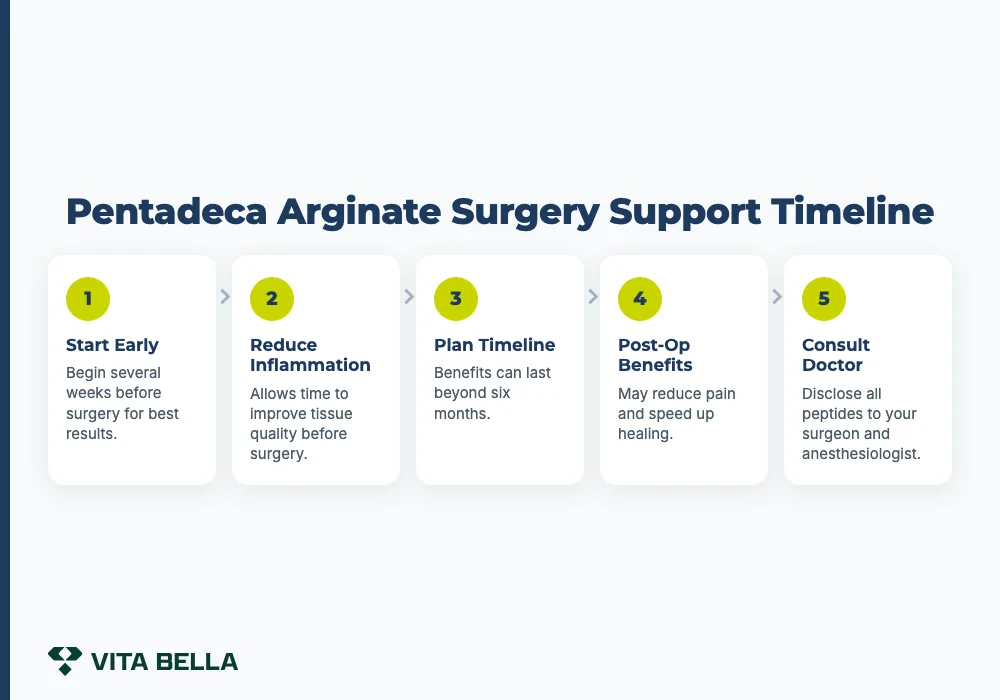
Starting a perioperative peptide protocol several weeks before a planned procedure gives PDA time to reduce baseline inflammation and improve tissue quality going in. That pre-habilitation effect can translate directly to stronger rehabilitation outcomes post-op.
Planning your perioperative timeline
For pentadeca arginate surgery preparation, durability matters. Lee & Padgett (2021) reported benefits persisting well past the three-to-six-month window, suggesting tissue-level changes accumulate rather than fade. Patients entering surgery with reduced baseline joint pain typically show earlier mobility milestones during rehabilitation.
Post-operatively, PDA may reduce pain, accelerate incisional repair, and support earlier functional milestones such as weight-bearing and range-of-motion recovery. For surgeries involving tendon, ligament, mucosal, or vascular repair, the tissue-specific repair properties documented in BPC-157 research are especially relevant.
Before starting any perioperative peptide, disclose it to your surgeon and anesthesiologist. Anticoagulation schedules, infection-prevention protocols, and anesthesia planning all need to account for every compound in your regimen. A licensed provider determines the dose after reviewing your medical history, and structuring a peptide protocol safely requires that conversation before the procedure.
Does PDA reduce post-surgical inflammation?
Yes. PDA reduces post-surgical inflammation through angiogenesis support, nitric oxide system modulation, and direct cellular repair signals across multiple tissue types.
A 2025 review in Pharmaceuticals (Sikiric et al.) described BPC-157's ability to control and modulate angiogenesis and the nitric oxide system, mechanisms that directly drive post-op inflammation relief at the surgical site. That review also confirmed the absence of serious adverse effects across all available human data.
A 2024 pilot study (Lee, Walker & Ayadi) added further signal: a single intravesical BPC-157 injection produced rapid symptom resolution in patients with moderate to severe interstitial cystitis, showing the compound's inflammation control extends to mucosal tissue.
PDA is an adjunct, not a replacement. It works alongside analgesics, infection prophylaxis, and rehabilitation protocols. Providers monitor pain scores, wound integrity, and functional milestones to evaluate individual response.
Is pentadeca arginate safe to use around surgery?
Current evidence supports a favorable safety profile. Sikiric et al. (2025) reported that lethal dose thresholds were not reached in human-translatable data, and no serious adverse effects appeared across any available human usage context.
Surgery introduces stressors on its own. Adding a compound with unresolved safety signals would be inappropriate. BPC-157 and PDA have not shown interaction signals with standard surgical medications in the existing literature, though large-scale randomized trials in surgical populations have not yet been completed.
Disclose PDA use to your full surgical team before any procedure. It should be included in the complete perioperative medication review. If the procedure has specific pharmacological demands, your provider adjusts the protocol accordingly.
Start your recovery plan with Vita Bella
Surgery recovery does not have to stretch for months. A licensed Vita Bella provider evaluates whether pentadeca arginate surgery support fits your procedure timeline, coordinates with your surgical team, and builds a perioperative protocol around your recovery goals.
Frequently asked questions
PDA is used to support tissue repair, reduce inflammation, and aid recovery from joint injuries, partial muscle and tendon tears, and surgical procedures. It promotes angiogenesis and collagen synthesis through the same core mechanism as BPC-157.
PDA is the arginate-salt form of BPC-157 and shares the same 15-amino-acid sequence, so their mechanisms and expected outcomes in recovery contexts are essentially identical. Human studies on BPC-157 directly inform expectations for PDA, including durable pain relief and accelerated tissue repair.
Most providers consider starting PDA several weeks before a planned procedure to reduce baseline inflammation and improve tissue quality. Exact timing depends on procedure type, health status, and any anticoagulation or infection-prevention protocols the surgical team has in place.
Yes, PDA modulates angiogenesis and nitric oxide signaling in ways that reduce post-surgical inflammation and support tissue repair. It is used alongside analgesics and rehabilitation protocols rather than as a replacement for them.
Current human evidence for BPC-157, which shares PDA's core sequence, shows no serious adverse effects and a favorable tolerability profile. Patients should disclose PDA use to their full surgical team so it can be included in the perioperative medication review.
Sources
- Lee, E., & Padgett, B. (2021). Intra-articular injection of BPC 157 for multiple types of knee pain. Alternative Therapies in Health and Medicine. PubMed
- Seiwerth, S., et al. (2021). Stable gastric pentadecapeptide BPC 157 and wound healing. Frontiers in Pharmacology. PubMed
- Sikiric, P., et al. (2025). Stable gastric pentadecapeptide BPC 157 as a therapy and safety key. Pharmaceuticals. PubMed
- Lee, E., Walker, C., & Ayadi, B. (2024). Effect of BPC-157 on symptoms in patients with interstitial cystitis: A pilot study. Alternative Therapies in Health and Medicine. PubMed