
Enclomiphene vs Clomid is a real decision for men with low testosterone who want treatment that keeps sperm production running. Both drugs stimulate the brain to release more LH and FSH, driving the testes to produce testosterone naturally. Sperm stays intact. That makes both central options in hormone therapy for male hypogonadism, though they differ in pharmacology, tolerability, and what the evidence shows head-to-head. The key distinction is chemistry: clomiphene is a two-isomer mixture, enclomiphene is the purer, faster-clearing half.
How enclomiphene and clomiphene work
Clomiphene citrate is a racemic mixture of two isomers. Enclomiphene is the trans isomer; zuclomiphene is the cis isomer. Each behaves differently.
Zuclomiphene has a half-life of roughly 30 days and carries measurable estrogenic activity. It accumulates with repeated dosing. Enclomiphene clears in about 10 to 10.5 hours. No estrogenic effect. Both isomers block estrogen receptors at the hypothalamus and pituitary, signaling the brain that estrogen is low and prompting it to release more LH and FSH. Elevated gonadotropins then tell the testes to produce testosterone while maintaining sperm output.
Enclomiphene is the purified trans isomer only, without zuclomiphene's accumulating estrogenic load. That pharmacological difference is the foundation of most of what the clinical data shows when comparing clomiphene vs enclomiphene head to head.
Enclomiphene vs Clomid: comparison at a glance
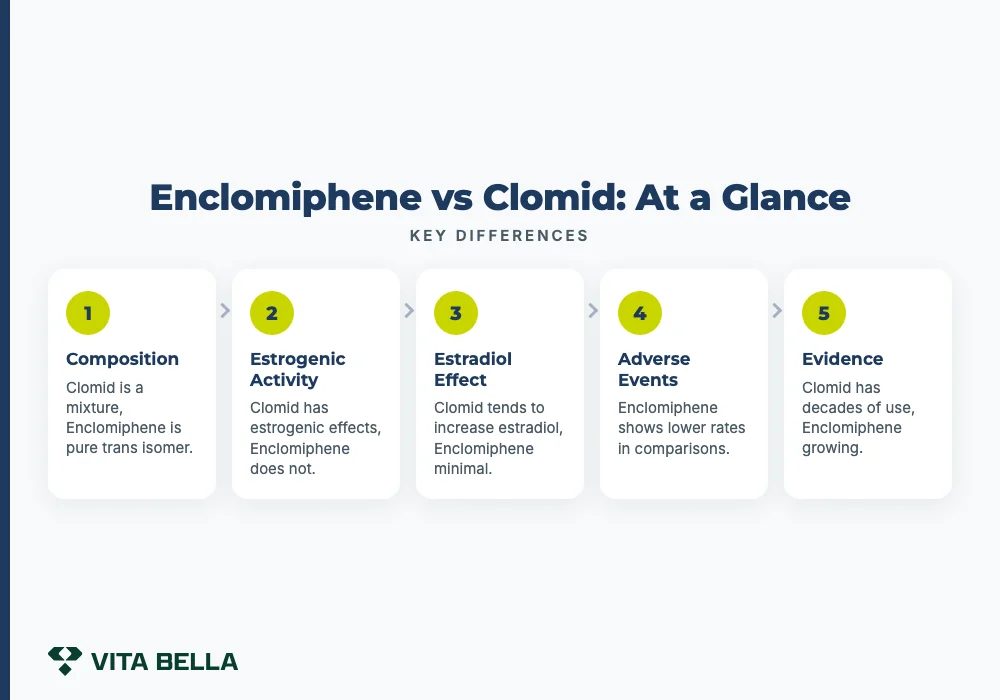
| Feature | Clomiphene (Clomid) | Enclomiphene |
|---|---|---|
| Composition | Racemic mixture (trans + cis isomers) | Trans isomer only |
| Cis isomer half-life | ~30 days | Not applicable |
| Trans isomer half-life | ~10–10.5 hours | ~10–10.5 hours |
| Estrogenic activity | Present (zuclomiphene) | None |
| Effect on estradiol | Tends to increase | Minimal to none |
| Gonadotropin response | Raises LH and FSH | Raises LH and FSH; stronger signal in some data |
| Sperm production | Preserved | Preserved |
| Clinical evidence depth | Decades of use | Growing evidence base |
| Documented adverse event rate | Higher in head-to-head comparisons | Lower in head-to-head comparisons |
Both drugs support testosterone without TRT by keeping the hypothalamic-pituitary-testicular axis engaged. The enclomiphene vs Clomid question has no single universal answer: the differences show up in tolerability, estradiol levels, and how the hormone panel looks over time.
Is enclomiphene better than Clomid for men?
Enclomiphene is not categorically better, but it shows a measurably cleaner tolerability profile in the available head-to-head data. For men who experience side effects on clomiphene, the advantage is clinically meaningful.
In a 2024 retrospective study published in Translational Andrology and Urology, 66 men who switched from clomiphene to enclomiphene showed a median testosterone increase of 166 ng/dL on enclomiphene versus 98 ng/dL on clomiphene (p = 0.20). The testosterone difference did not reach statistical significance. Estradiol told a different story.
Enclomiphene was associated with a decrease of approximately 5.92 pg/mL; clomiphene, with an increase of roughly 17.50 pg/mL (p = 0.001). Adverse events including reduced libido, fatigue, and mood changes occurred significantly less often on enclomiphene (OR 0.18, 95% CI 0.07 to 0.44, p = 0.02).
A 2024 analysis in the Journal of Sexual Medicine confirmed that enclomiphene avoids many of the estrogenic side effects tied to zuclomiphene, including mood swings and gynecomastia.
Both drugs raise testosterone to comparable levels. Enclomiphene does it with less estradiol elevation and fewer documented adverse events. The enclomiphene vs Clomid gap is not a testosterone gap; it is a tolerability gap. That matters most for men whose side-effect burden determines whether they stay on treatment.
Can enclomiphene replace Clomid for low testosterone?
Yes. For most men with Clomid for male hypogonadism already on their radar, enclomiphene is a viable alternative with comparable testosterone outcomes and a better-documented tolerability profile. Whether it is the right replacement depends on the individual's lab values, fertility timeline, and treatment history.
A 2025 systematic review and meta-analysis in Archives of Endocrinology and Metabolism evaluated both clomiphene and enclomiphene in randomized controlled trials for male hypogonadism, supporting their use as gonadotropin-stimulating therapies. Neither drug replaces exogenous testosterone for men whose testes have lost meaningful reserve. For men who retain testicular function, either can deliver an enclomiphene testosterone boost or a clomiphene-driven rise without the fertility suppression that TRT carries.
Clomiphene has decades of efficacy data behind it. A 2023 systematic review and meta-analysis in Andrology by Huijben et al. covered its use across studies of male infertility, establishing a deep evidence base that reassures both providers and patients. Enclomiphene's evidence is newer and smaller in volume, but it is growing. Its profile is especially relevant when estrogenic load is a concern.
For men whose priority is keeping sperm production active during testosterone treatment, either modulator starts from a stronger position than exogenous testosterone alone.
What are the side effects of Clomid compared to enclomiphene in men?
Clomiphene side effects in men are largely driven by zuclomiphene, the cis isomer that accumulates between doses. Enclomiphene removes that accumulation by design.
The most commonly documented complaints include reduced libido, fatigue, and mood changes. Estrogenic effects such as gynecomastia also appear in the literature. These trace back to zuclomiphene's estrogenic receptor activity and its 30-day half-life, which means it builds up predictably over weeks of treatment.
In the 2024 switch study, men who moved from clomiphene to enclomiphene reported significantly fewer of these complaints, with an odds ratio of 0.18 for adverse events. That is a substantial reduction. Short half-life changes the picture entirely.
Enclomiphene clears in roughly 10 to 10.5 hours. No zuclomiphene accumulation. Estradiol stays closer to baseline, removing a primary driver of the mood and libido disruptions men often report on clomiphene.
Both drugs can, in principle, push LH high enough to cause testicular discomfort at high stimulation levels, and both require monitoring for this reason. The tolerability advantage of enclomiphene matters most for men who have already experienced estrogenic symptoms on clomiphene or who enter treatment with elevated baseline estradiol.
Men who tolerate clomiphene without problems have no urgent clinical reason to switch. The enclomiphene vs Clomid tolerability advantage is most relevant where clomiphene's side-effect profile creates friction with adherence.
Does enclomiphene preserve fertility better than Clomid?
Both drugs preserve fertility. That shared advantage over TRT is the main reason providers reach for them in men who want to conceive. The sharper question is whether enclomiphene supports sperm production more actively.
In a 2023 retrospective study in Cureus comparing 46 men on enclomiphene with 32 men on clomiphene, both groups achieved significant increases in total testosterone. Only the enclomiphene group demonstrated statistically significant increases in LH and FSH. Total motile sperm count rose in both groups, but the increase reached statistical significance only in the enclomiphene arm (p < 0.05).
Enclomiphene fertility preservation data is early but consistent with the mechanistic expectation: a stronger, cleaner gonadotropin signal should translate into better sperm support.
The 2023 Huijben et al. meta-analysis in Andrology reinforces clomiphene's track record for improving sperm parameters in idiopathic male infertility. That evidence base is broad and well-established. Clomiphene remains a solid option for men who need fertility support and prefer a compound with a long clinical history.
For men actively trying to conceive, either compound is a reasonable starting point. Enclomiphene's stronger gonadotropin signal in the Cureus data gives it a possible edge in sperm output. Lab-based provider review determines which one fits the individual case.
How long does enclomiphene take to raise testosterone levels?
Enclomiphene begins stimulating LH and FSH within hours of the first dose, given its short half-life. Observable changes in testosterone typically take weeks because the testes need time to respond to the increased gonadotropin signal. Lab results lag. Symptoms often move first.
Most providers check testosterone, LH, FSH, and estradiol at roughly three months to assess initial response, and again at six months to confirm the longer-term trend. Some men notice improvements in energy or libido within four to eight weeks, before the next lab draw confirms what is happening hormonally.
Clomiphene's longer half-life means zuclomiphene accumulates over several weeks before reaching steady state. Some men find the accumulation phase creates day-to-day variability in how the treatment feels. Enclomiphene, clearing daily, produces a more consistent gonadotropin stimulus without that build-up period.
The enclomiphene vs Clomid pharmacokinetic contrast also matters for men who travel or have variable schedules: daily clearance means a missed dose carries less compounding impact than it does with a compound whose active isomer persists for weeks.
For a detailed look at what the response timeline looks like in practice, see enclomiphene treatment timelines and what results to expect.
Enclomiphene vs Clomid: how a provider makes the call
Both drugs achieve broadly similar testosterone outcomes. The choice comes down to individual factors that only a full hormone panel and patient history can surface.
Estradiol is the first filter. Men with elevated baseline estradiol or a history of estrogenic side effects on other treatments are typically better candidates for enclomiphene. Men with normal estradiol who need a well-established, well-documented option may start with clomiphene.
The 2018 AUA Guideline on Testosterone Deficiency Management states that treatment decisions must be individualized based on patient goals, lab results, and overall health status. The 2025 EAU Male Hypogonadism Guidelines similarly require a full baseline endocrine assessment before initiating any gonadotropin-stimulating therapy.
Fertility timeline is the second consideration. Men actively trying to conceive within a defined window may benefit from enclomiphene's stronger gonadotropin signal, based on the 2023 Cureus data showing more significant LH, FSH, and total motile sperm count improvements in that arm. Men whose goal is preservation rather than immediate conception may respond equally well to either compound.
Prior treatment experience tells the provider a great deal. A documented history of libido, energy, or mood complaints on clomiphene directly informs the switching decision. The 2024 Translational Andrology and Urology data showed a fivefold reduction in documented adverse events when patients moved from clomiphene to enclomiphene.
SHBG level adds another dimension. How SHBG shapes your testosterone panel influences how aggressively a provider stimulates gonadotropin output, because high SHBG binds free testosterone tightly and may require a stronger response to produce measurable benefit at the tissue level.
At Vita Bella, a licensed provider determines the dose after reviewing labs, symptom history, fertility goals, and prior treatment response. No protocol is set without that full clinical picture.
What to monitor on either compound
Regular lab monitoring keeps both treatments safe and on target. The standard check covers total and free testosterone, LH, FSH, and estradiol at three to six month intervals. These markers confirm whether the gonadotropin stimulus is working and whether estradiol is climbing to a level that needs attention.
Semen analysis matters for men on a fertility track. Sperm count, motility, and total motile sperm count tell the provider whether the signal is translating into improved output. The 2023 Cureus retrospective found statistically significant total motile sperm count improvement only in the enclomiphene arm, which is why repeat semen analysis at three and six months helps providers track which direction the data is moving.
Hematocrit needs monitoring too. Elevated testosterone from any source can increase red blood cell production. Routine blood counts catch that trend early.
Men on clomiphene should watch estradiol closely. Zuclomiphene's estrogenic activity can push estradiol upward even when testosterone looks well-controlled. Catching that drift early is exactly what the switch-study data was measuring.
Neither compound requires perfect labs to begin. A provider reviews the panel and determines whether the response is sufficient, whether any adjustment is warranted, and when the next check should occur.
Ready to find the right protocol?
If low testosterone is affecting your energy, libido, or fertility goals, a provider-led evaluation is the right starting point. Get Started to connect with a licensed provider who can review your labs and determine whether enclomiphene, clomiphene, or another hormone therapy approach fits your clinical picture.
Frequently asked questions
Enclomiphene has not received regulatory approval for use in men; it remains investigational for male hypogonadism and is prescribed off-label where clinically appropriate. Clomiphene carries regulatory approval for female ovulatory disorders only and is similarly used off-label in men.
Yes. Both clomiphene and enclomiphene raise testosterone by stimulating the body's natural production pathway, which keeps the hypothalamic-pituitary-testicular axis active and sperm production intact. This makes them a genuine alternative for men who want testosterone support without the fertility suppression that exogenous testosterone typically causes.
Both compounds work by stimulating your own hormone production, so stopping them typically allows testosterone to return toward pre-treatment baseline over time. The rate depends on how responsive your hypothalamic-pituitary-testicular axis is. A provider can guide a structured approach to tapering if discontinuation becomes the plan.
Clomiphene tends to raise estradiol because zuclomiphene carries estrogenic activity and accumulates over weeks. Enclomiphene does not carry that load; the 2024 switch study found a statistically significant difference in estradiol change between the two compounds (p = 0.001). Men who are sensitive to estrogenic effects generally tolerate enclomiphene better.
Sources
- Saffati G et al. (2024). Safety and efficacy of enclomiphene and clomiphene for hypogonadal men. Translational Andrology and Urology. Source
- Kassab J et al. (2024). Safety and efficacy of enclomiphene compared to clomiphene for hypogonadal men. Journal of Sexual Medicine. Source
- Hohl A et al. (2025). Clomiphene or enclomiphene citrate for the treatment of male hypogonadism: a systematic review and meta-analysis of randomized controlled trials. Archives of Endocrinology and Metabolism. PubMed
- Huijben M et al. (2023). Clomiphene citrate for male infertility: A systematic review and meta-analysis. Andrology. PubMed
- Thomas J et al. (2023). Efficacy of clomiphene citrate versus enclomiphene citrate for male infertility treatment: A retrospective study. Cureus. Source
- Mulhall JP et al. (2018). Evaluation and management of testosterone deficiency: AUA guideline. The Journal of Urology. PubMed
- Salonia A et al. (2025). European Association of Urology guidelines on male sexual and reproductive health: 2025 update. European Urology. PubMed