Pentadeca arginate (PDA) is a synthetic peptide for tissue repair. It targets joints, muscles, tendons, and the gut lining through multiple biological pathways. The arginate modification sets it apart from BPC-157, the parent compound, by improving stability and tissue delivery. For anyone managing persistent joint pain, slow post-injury recovery, or chronic muscle soreness, peptide therapy at Vita Bella pairs this compound with licensed provider oversight.
What is pentadeca arginate used for?
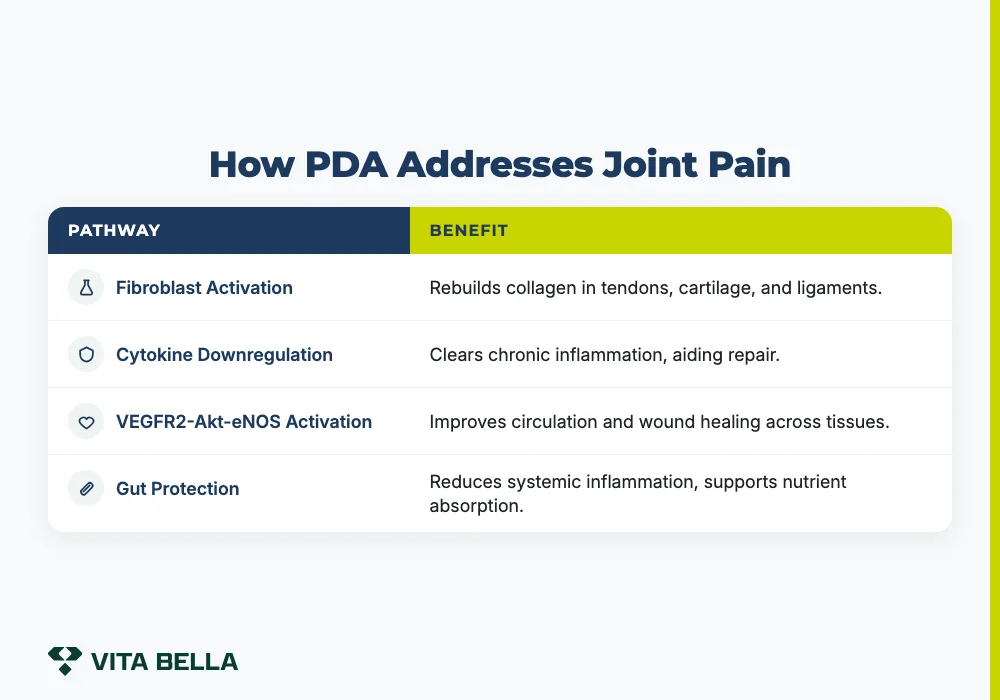
PDA addresses joint pain through four biological pathways, not just one. Each reinforces the others. PDA peptide benefits extend from fibroblast activation and cytokine regulation to improved circulation and gut integrity.
- Fibroblast activation rebuilds the collagen in tendons, cartilage, and ligaments. A 2018 study in the International Journal of Molecular Sciences (Chang et al.) showed that pentadecapeptide BPC-157 enhances growth hormone receptor expression in tendon fibroblasts, the cells responsible for producing structural collagen.
- TNF-α and IL-6 downregulation clears the chronic inflammation that delays repair. Research by Sikiric and Hahm (2020) in Gut and Liver identified this cytokine-regulating action as central to the compound's cytoprotective profile.
- VEGFR2-Akt-eNOS pathway activation improves circulation and wound healing across multiple tissue types at once. A 2023 study in Pharmaceuticals (Sikiric et al.) documented this effect and noted the compound's high capacity for simultaneous multi-tissue repair.
- Gastrointestinal mucosal protection reduces systemic inflammation and supports nutrient absorption. A 2021 review in Neural Regeneration Research (Vukojević et al.) linked this gut-protective action to improved recovery conditions throughout the body.
No single mechanism does everything. Together, these pathways address circulation, structural rebuilding, and inflammation control at the same time. That multi-pathway activity separates it from single-target compounds.
How does pentadeca arginate compare to BPC-157?
The core is the same. PDA is structurally derived from BPC-157, the well-researched 15-amino acid pentadecapeptide with a large body of preclinical data on tissue regeneration, neuroprotection, and gut repair. The arginate salt form adds greater resistance to degradation, which translates to more consistent tissue delivery.
BPC-157 carries the stronger research record. A 2025 review in Pharmaceuticals (Sikiric et al.) documented no adverse effects across major organ systems in BPC-157 studies, including the brain, heart, lungs, liver, kidneys, and gastrointestinal tract. PDA has not completed human trials yet. Its safety and efficacy profile is currently inferred from that BPC-157 data.
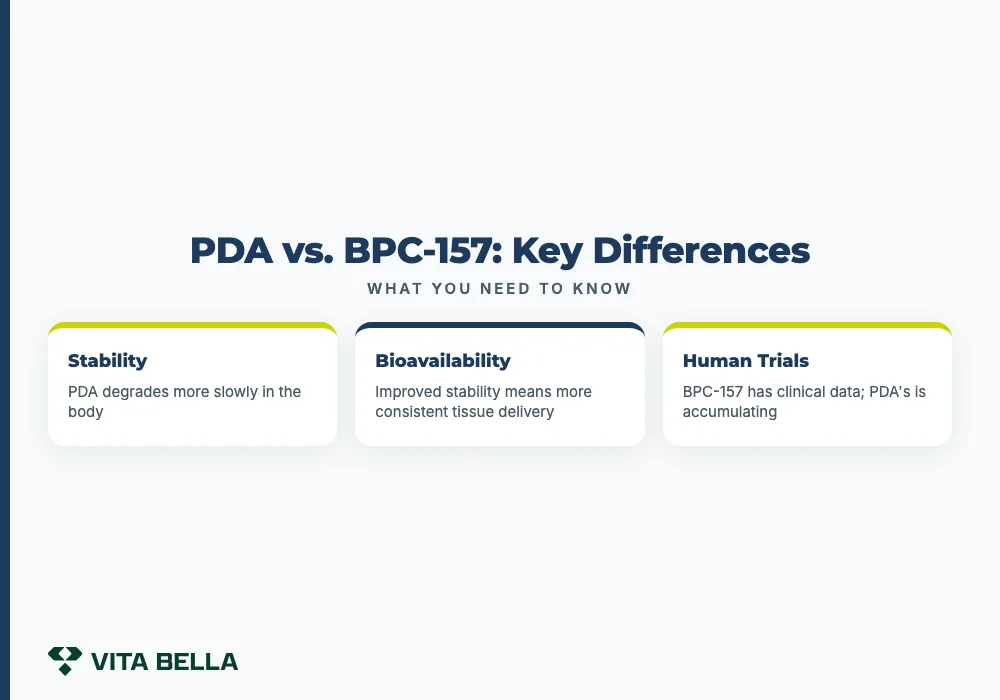
For anyone considering pentadeca arginate as a BPC-157 alternative peptide, three differences stand out:
- Stability: the arginate form degrades more slowly in the body.
- Bioavailability: improved stability means more consistent delivery to target tissue.
- Human trial data: BPC-157 has clinical data; PDA's evidence base is still accumulating.
The mechanism is similar. The open question is whether the stability improvement changes outcomes measurably in human tissue over time.
How pentadeca arginate supports connective tissue healing
Tendons and cartilage recover slowly. They receive limited blood supply. PDA addresses this at the cellular level.
The 2018 study by Chang et al. found that pentadecapeptide BPC-157 directly enhances growth hormone receptor expression in tendon fibroblasts, the cells that produce structural collagen for rebuilding extracellular matrix (ECM) integrity in tendons, cartilage, and ligaments.
That mechanism matters because anti-inflammatory effects alone are not enough. Joint stiffness often persists long after active inflammation has resolved, because the ECM hasn't fully rebuilt. A joint pain peptide that stops at reducing swelling misses the structural half of recovery. PDA's activity on fibroblasts provides the cellular signal for tissue reconstruction to occur, not just symptom management.
Peptides for injury and athletic recovery covers how these compounds integrate into broader recovery programs at Vita Bella.
The brain-gut-muscle axis: what most recovery guides don't explain
The gut and the brain communicate constantly. That communication has real downstream effects on muscle function and recovery.
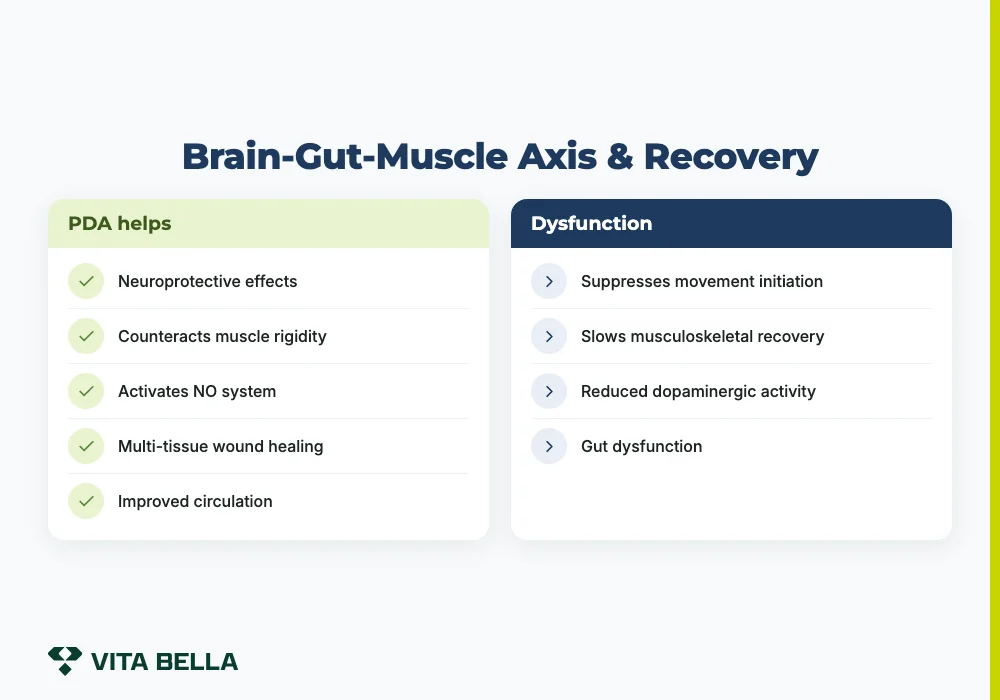
A 2021 review in Neural Regeneration Research (Vukojević et al.) described how pentadecapeptide BPC-157 acts on the brain-gut axis, producing neuroprotective effects and counteracting muscular rigidity linked to reduced dopaminergic cell activity in the motor pathway. In practical terms: gut dysfunction can suppress movement initiation and slow musculoskeletal recovery. Pentadecapeptides engage the pathway that addresses this.
The 2023 Pharmaceuticals study (Sikiric et al.) expanded the picture. BPC-157 was shown to affect the entire nitric oxide (NO) system, activating the VEGFR2-Akt-eNOS signaling pathway and demonstrating high capacity for simultaneous multi-tissue wound healing. This is why the muscle recovery peptide case for pentadeca arginate extends beyond any specific injury site.
Systemic effects including improved circulation, gut integrity, and neuroprotective properties together build a better environment for repair throughout the body.
Is pentadeca arginate safe for humans?
No direct human trial data for PDA exists yet. Safety evidence comes from BPC-157 research.
A 2025 review in Pharmaceuticals (Sikiric et al.) noted the absence of adverse effects across multiple organ systems in BPC-157 studies, including the brain, heart, lungs, liver, kidneys, and gastrointestinal tract. That breadth of organ-system coverage supports the compound's cytoprotective classification.
The honest caveat: BPC-157's safety record doesn't automatically transfer to pentadeca arginate. The arginate modification is structurally minor, but any compound entering clinical use requires its own data. At this stage, the safety profile for PDA is inferred, not directly established.
A licensed provider who recommends anti-inflammatory peptide therapy weighs that limitation against the available evidence and the patient's full health picture.
How long does pentadeca arginate take to work?
No established timeline exists for PDA specifically. Recovery speed depends on tissue type, condition severity, and baseline health.
Tendons and cartilage are less vascularized than muscle. They repair more slowly regardless of peptide support. Early reductions in joint discomfort may appear within the first few weeks for some users. Full connective tissue remodeling takes considerably longer than initial symptom relief.
Quarterly provider check-ins give a licensed provider the opportunity to track whether the response is progressing and to adjust the protocol as needed. Labs are recommended rather than required before a peptide protocol; they help individualize dosing and establish a baseline for monitoring progress.
What are the side effects of pentadeca arginate?
Based on BPC-157 studies reviewed to date, no serious adverse effects in major organ systems have been reported. Mild injection-site reactions are possible with any subcutaneously administered compound.
Because human-specific trials are not yet complete, the side-effect profile is extrapolated from BPC-157 data. This is the safety gap that providers name openly when discussing PDA: the preclinical and early-phase evidence looks favorable, but the evidence base for PDA itself is still being built.
Understanding safe peptide cycling and how protocols are structured helps set realistic expectations about duration, monitoring, and what a licensed provider adjusts over time.
Start your recovery protocol
Vita Bella builds provider-guided programs that include this peptide for joint repair, muscle recovery, and connective tissue support. A licensed provider determines the appropriate dose after reviewing your health history. Labs are recommended to help individualize the approach. Get Started to begin.
Frequently asked questions
PDA supports tissue repair in joints, muscles, tendons, and cartilage through four mechanisms: fibroblast activation, cytokine regulation, nitric oxide pathway activation, and gut mucosal protection. It is used in provider-guided programs for musculoskeletal recovery. Research on the closely related compound BPC-157 provides the current evidence base.
PDA shares the same 15-amino acid core sequence as BPC-157 but uses an arginate salt form for improved stability and tissue delivery. BPC-157 has significantly more published research; PDA's safety and efficacy profile currently draws on that data while direct human trial evidence continues to accumulate.
Direct human trial data does not yet exist for PDA. BPC-157 studies reviewed in Pharmaceuticals (2025) found no adverse effects across major organ systems. A licensed provider weighs this inferred safety profile against each patient's individual health picture before recommending use.
No established clinical timeline exists for PDA. Recovery speed depends on tissue type, condition severity, and individual health factors. Connective tissue repair is slower than muscle recovery due to lower blood supply, and a provider monitors progress at quarterly check-ins.
Based on BPC-157 research, no serious adverse effects in major organ systems have been reported to date. Mild injection-site reactions are possible with subcutaneously administered compounds. Because human-specific trials for this compound are not yet complete, the side-effect profile is inferred from BPC-157 data.
Sources
- Chang, C.-H., Tsai, W.-C., Hsu, Y.-H., & Su Pang, J.-H. (2018). Pentadecapeptide BPC 157 enhances the growth hormone receptor expression in tendon fibroblasts. International Journal of Molecular Sciences, 19(4), 1117. PubMed
- Sikiric, P., & Hahm, K.-B. (2020). Stable gastric pentadecapeptide BPC 157, Robert's stomach cytoprotection / adaptive cytoprotection / organoprotection, and Selye's stress coping response. Gut and Liver, 14(2), 153–167. PubMed
- Vukojević, J., Milavić, M., Perović, D., Ilić, S., et al. (2021). Pentadecapeptide BPC 157 and the central nervous system. Neural Regeneration Research, 16(8), 1551–1559. PubMed
- Sikiric, P., Gojkovic, S., Krezic, I., Smoday, I. M., & Kalogjera, L. (2023). Stable gastric pentadecapeptide BPC 157 may recover brain–gut axis and gut–brain axis function. Pharmaceuticals, 16(5), 676. PubMed
- Sikiric, P., Seiwerth, S., Skrtic, A., Staresinic, M., et al. (2025). Stable gastric pentadecapeptide BPC 157 as a therapy and safety key: a special beneficial pleiotropic effect controlling and modulating angiogenesis and the NO-system. Pharmaceuticals, 18(6), 928. PubMed